
Technical Manual for Brushless Motors
Information as of January 2019.
Brushless motors are excellent in terms of speed controllability and energy conservation. Compared to using inverters and firing angle control to control the speed of induction motors, these motors can be used at a wide range of speeds, from low speed rotation to high speed rotation. In addition, permanent magnets are used in the rotor, and because there is no need to induce current into the rotor as with induction motors, brushless DC motors are compact and offer high output power and efficiency.
In addition to the principles and features of brushless motors, this technical manual also explains how they can be used for different purposes to other speed control motors, such as AC speed control motors and inverters.
Table of Contents
Preface
-
1. Types of Brushless Motors
- 1.1. Inner Rotor Type
- 1.2. Outer Rotor Type
- 1.3. Disk Rotor Type
-
2. Structure and Principles of Brushless Motors
- 2.1. Structure and Rotation Principles of DC Motors
- 2.2. Structure and Rotation Principles of Brushless Motors
- 2.3. Main Components of Brushless Motors
-
3. Drive System of Brushless Motors
- 3.1. Motor Drive System
- 3.2. Drive Systems and Motor Torque
- 3.3. Current Control Methods
-
4. Control Principles of Brushless Motors
- 4.1. Basic Drive Circuit Configuration and Roles
- 4.2. Methods of Speed Control
- 4.3. High Accuracy Drive Circuit Configuration and Roles
- 4.4. Methods of Torque Control
- 4.5. Braking (Regenerative Operation)
-
5. Technology Used in Brushless Motors
- 5.1. Wide Speed Control Range (Low-Speed Operation)
- 5.2. Wide Speed Control Range (High-Speed Operation)
- 5.3. High-Accuracy Speed Control
- 5.4. Stable Stop Position
- 5.5. High Efficiency and Energy Saving
- 5.6. Compact and Lightweight Motor
- Afterword
Please download the PDF from the link below to read more.
1. Types of Brushless Motors
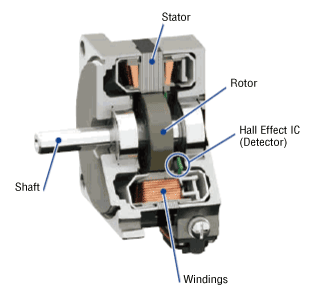
Brushless motors can function as motors by combining permanent magnets, windings, sensors, and drive circuits. Since there are few structural constraints, specialized motors with optimal structures have been devised for different applications. The following is a description of the typical structures and features of one of these specialized motors.
1.1. Inner Rotor Type
The rotor (rotating part) is located inside the stator (stationary part), and permanent magnets are arranged on the surface. Since the rotor is thin with small inertia, it is highly responsive during acceleration and deceleration. Also, the stator is located close to the surface of the motor, making it a compact motor with good heat dissipation and high output power.
This shape is common for brushless motors and is used in a wide range of applications. Our brushless motors are the inner rotor type.
You can download the full text on this topic in PDF format.